Table of Contents
If you have come across Inksnation through a WhatsApp group, an agent promising “salary for life,” or a friend who’s already invested, you’re right to pause and ask questions before putting any money in.
Thousands of Nigerians are asking the same thing right now, and the answers involve a real regulatory body, a real arrest, and a coin that traded on nothing but hype.
This guide breaks down exactly how the scheme worked, what Nigerian authorities did about it, and how to protect your money from similar Ponzi schemes going forward.
Is Inksnation Legit? The Short Verdict
Inksnation is not legit. It is a confirmed Ponzi scheme that Nigerian regulators shut down. Here is the verdict at a glance:
- The Securities and Exchange Commission (SEC) declared it illegal: In 2020, the SEC warned Nigerians that Inksnation and its parent company, iBSmartify Nigeria, were not registered and were operating unlawfully.
- The founder was declared wanted, then arrested: The EFCC declared Omotade-Sparks Amos Sewanu wanted in November 2020 over an alleged ₦32 million fraud. He was arrested in Sokoto on May 27, 2021.
- Pinkoin was never a real cryptocurrency: As of July 2026, Pinkoin has never been listed on CoinMarketCap, CoinGecko, or any recognized exchange, and no public blockchain for it has ever been verified.
If you are still searching for the Inksnation login page hoping to withdraw your balance, the hard truth is that the figures in those dashboards were never backed by real money. Any funds paid into the scheme are almost certainly gone.
What Is Inksnation and Pinkoin?
Inksnation was a Nigerian “blockchain” project that promised members a guaranteed monthly income for life in exchange for a small one-time payment. It marketed itself as the world’s first philanthropic blockchain, claiming it could end poverty in any country in under nine months.
The Company and Founder Behind Inksnation
Inksnation was promoted by iBSmartify Nigeria, a company founded by Omotade-Sparks Amos Sewanu, who called himself “Universal Daddy Ink” (UDI). The project launched around 2019 and spread rapidly through Telegram and WhatsApp groups, referral agents, and social media campaigns.
Sewanu made extraordinary claims. He said he had invented the world’s first “charitable” blockchain (InksLedger), the world’s first reserve cryptocurrency (Pinkoin), and Africa’s first QR debit card (Pinkard). He even wrote a public letter to the EFCC claiming his system could pay every Nigerian, including newborn babies, ₦120,000 monthly. None of these claims was ever independently verified.
What Pinkoin, Pinkard, and the “Living Nodes” Promised
The pitch was simple and seductive. Members paid an activation fee, typically between ₦1,000 and ₦10,000, to become a “Living Node” on the network. In return, Inksnation promised:
- A “salary for life” of up to ₦120,000 per month, paid in Pinkoin
- A Pinkard debit card that would supposedly let members spend their Pinkoin anywhere
- Referral bonuses for bringing in new members
Members watched their dashboard balances grow into millions of naira worth of Pinkoin. But the numbers were fiction. There was no way to convert Pinkoin to cash at scale, and withdrawal requests were met with delays, new fees, or silence.
Red Flags That Mark Inksnation as a Ponzi Scheme
Inksnation displayed nearly every classic warning sign of a Ponzi scheme. Understanding these red flags will help you evaluate any “investment” opportunity you come across.
1. “Salary for Life” With No Revenue Source
Every legitimate income stream is funded by something: sales, interest, dividends, or fees. Inksnation promised lifetime salaries to millions of members but never explained where the money would come from. The only money entering the system was activation fees and payments from new members – the textbook definition of how a Ponzi scheme operates.
A scheme that pays old members with new members’ deposits always collapses. The maths guarantees it.
2. A “Coin” With No Real Blockchain or Exchange Listing
Real cryptocurrencies run on public blockchains that anyone can inspect, and they derive market value from being bought and sold on open exchanges. Pinkoin failed both tests:
- No verifiable blockchain. The Stakeholders in Blockchain Technology Association of Nigeria (SiBAN) found no evidence that InksLedger actually existed.
- No exchange listing. Pinkoin has never appeared on CoinMarketCap, CoinGecko, or any recognised exchange. Its “value” was simply whatever Sewanu announced.
This pattern mirrors the infamous OneCoin scam, where a fake coin with a made-up price defrauded victims of billions of dollars worldwide.
3. Not Registered or Regulated by the SEC
Anyone offering investment products to the Nigerian public must be registered with the SEC. Inksnation and iBSmartify Nigeria were not. When the SEC investigated, it publicly declared the scheme illegal and warned Nigerians to steer clear. A platform that handles people’s money while dodging regulators is telling you everything you need to know.
What Nigerian Authorities Did About Inksnation
Nigerian regulators and industry bodies moved against Inksnation on multiple fronts between 2020 and 2021.
SEC Nigeria and SiBAN Scam Warnings
In 2020, the SEC issued a public warning declaring the activities of iBSmartify Nigeria (Inksnation’s promoter) illegal and advising Nigerians not to invest. Inksnation remains referenced among SEC Nigeria’s warnings on investment scams, which every investor should bookmark before putting money into any new platform.
In June 2020, SiBAN, the umbrella body for Nigeria’s blockchain industry, separately labeled Pinkoin a scam, warning that Inksnation operated a Ponzi model regardless of the founder’s stated intentions.
EFCC Wanted Notice and 2021 Arrest
In November 2020, the EFCC declared Omotade-Sparks Amos Sewanu wanted in a case involving obtaining by false pretence, name-dropping, and fraud amounting to ₦32 million. After six months on the run, he was arrested by the EFCC’s Sokoto Zonal Office on May 27, 2021.
If you lost money to Inksnation, report it through EFCC fraud reporting channels with evidence of your payments. Be warned: there is no official Inksnation refund programme, and anyone contacting you as a “recovery agent” who asks for an upfront fee is running a second scam on the same victims.
How to Spot and Avoid Ponzi Schemes Like Inksnation
Inksnation was neither the first nor the last scheme of its kind in Nigeria. Fraudsters recycle the same playbook, so learning the pattern protects you permanently. Watch for these warning signs:
- Guaranteed returns. No legitimate investment can promise fixed profits, and certainly not a “salary for life.”
- Recruitment pressure. If earnings depend on bringing in new members, the structure is a pyramid.
- No regulatory registration. Check the SEC’s database before investing. Unregistered means unprotected.
- Vague or impossible technology claims. “World’s first” everything, with no working product anyone can verify.
- Withdrawal friction. Growing dashboard balances you can never actually cash out.
- Urgency and hype. Countdown timers, “limited slots,” and pressure to act before you can think.
Studying past frauds is one of the best defences. Our breakdown of the biggest Bitcoin Ponzi schemes shows how the same red flags repeat across MMM, Racksterli, and dozens of others.
A Safer, Legitimate Way to Earn from Crypto – Prestmit
The appetite that drove people to Inksnation – earning real money from digital assets – is valid. The problem was the vehicle, not the goal. The safe path is using a registered, transparent platform where you exchange real assets at market rates, not a scheme that promises free money.
Prestmit is a virtual asset marketplace where Nigerians turn crypto and gift cards into cash – no fake balances, no salary promises, just a real asset for real Naira, usually within minutes. And unlike Inksnation, everything about how it works is visible before you commit.
Start with the rate calculator: it shows your exact payout upfront, so there’s no hidden fee and no renegotiating after your Bitcoin or USDT is already gone. What you see is what lands in your account. From there, the process runs on its own – send your crypto, and it converts to Naira automatically, with no counterparty to wait on and no price to haggle over.
That same reliability carries into how your funds are protected, with SSL encryption, two-factor authentication, and biometric login guarding every account, backed by support that’s available around the clock.
And Prestmit isn’t limited to one asset. Bitcoin, USDT, and several gift card brands all live on the same dashboard, so whether you’re looking to sell gift cards or sell Bitcoin, you never have to switch platforms to do it.
How to Sell Crypto for Cash on Prestmit
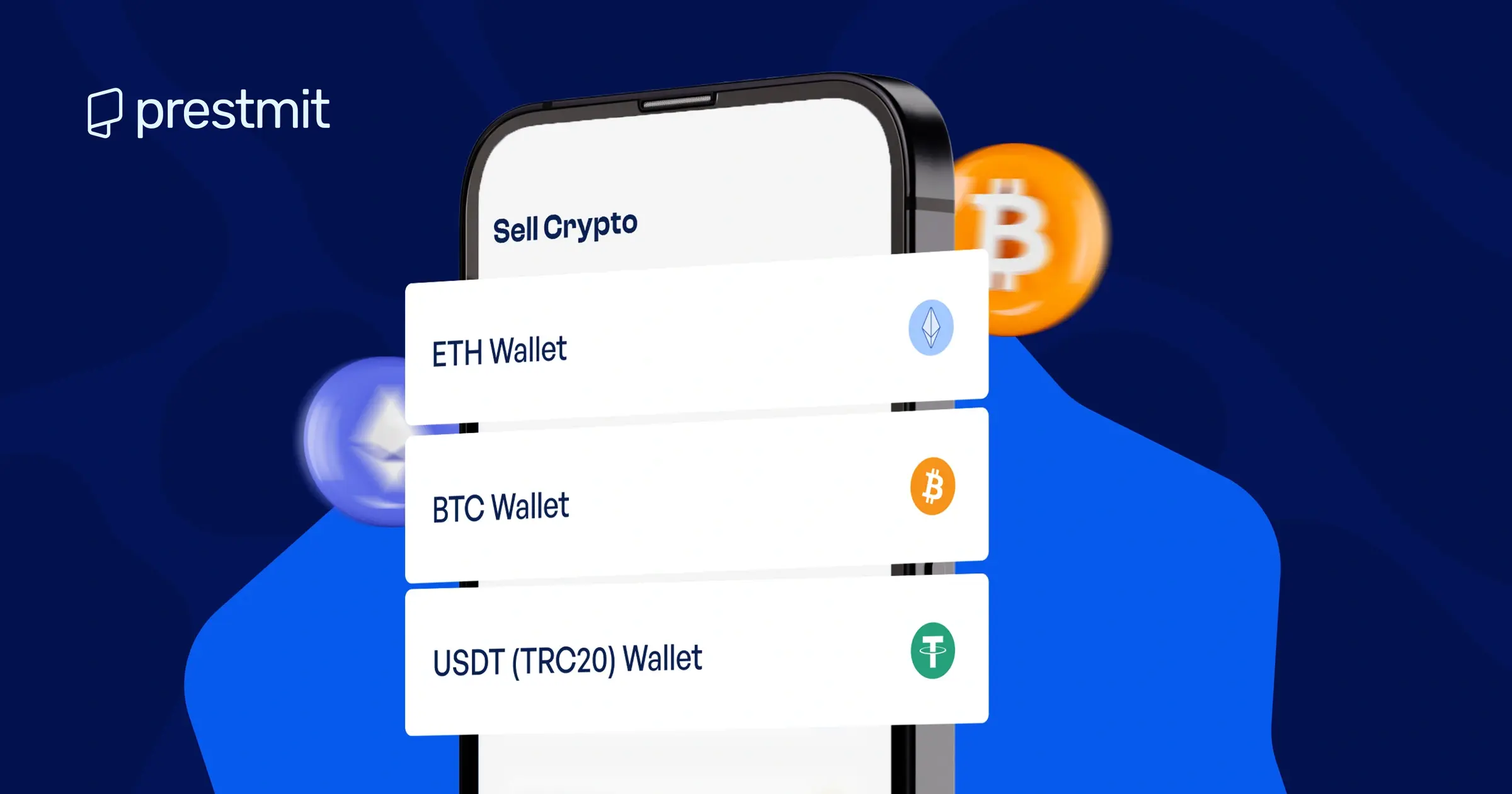
Selling crypto on Prestmit is fully automated. You generate a wallet address, send crypto to it, and your payout arrives in Naira, Cedis, or your USD wallet automatically; no manual steps needed after sending.
Step 1: Create an account
Visit the Prestmit website or download the Prestmit app from the Google Play Store or App Store.
Sign up and complete the account setup process.
Step 2: Go to the ‘Crypto” section
Log in to your account and click on the Crypto section on your dashboard.
Step 3: Choose the type of cryptocurrency to sell
Choose your preferred cryptocurrency from the list available on the platform.
Step 4: Generate wallet details
Generate the Prestmit wallet details for your chosen cryptocurrency (if it is your first time )
Step 5: Send crypto to your address
Send crypto from any wallet or exchange to your Prestmit address. After the required blockchain confirmations, your payout is processed automatically.
Step 6: Receive your payout
Once confirmed, the crypto is converted to your default fiat currency (Naira, Cedis, or USD) at the current rate. You don’t need to do anything.
Frequently Asked Questions
1. Is Inksnation still paying?
No. Inksnation has never made sustained, verifiable payouts, and there is no evidence of anyone converting large Pinkoin balances to cash. Any group claiming payments have “resumed” is attempting to revive the scheme and collect fresh deposits.
2. What is Pinkoin worth today?
Pinkoin is worth nothing. As of July 2026, it is not listed on CoinMarketCap, CoinGecko, or any recognised exchange, so it has no market price. The naira values shown in old Inksnation dashboards were arbitrary numbers, not real money.
3. Can I recover the money I lost to Inksnation?
There is no official Inksnation refund programme. Your best step is to report the fraud through official EFCC channels with proof of your payments (receipts, transfer records, chat evidence). Be careful: anyone calling themselves a “recovery agent” and demanding an upfront fee is running a second scam.
4. Was the Inksnation founder ever arrested?
Yes. The EFCC declared Omotade-Sparks Amos Sewanu wanted in November 2020 over an alleged ₦32 million fraud and arrested him in Sokoto on May 27, 2021, after six months on the run.
5. Is Inksnation.io coming back?
Treat any relaunch as a fresh scam. Promoters have attempted comebacks since the founder’s arrest, including recruiting “KYC agents” for a fee. The SEC’s declaration that the scheme is illegal still stands, so any new version carries the same risk of total loss.
Conclusion
Inksnation is a scam – the evidence leaves no room for doubt. The Securities and Exchange Commission (SEC) declared it illegal, SiBAN labelled Pinkoin fraudulent, and the EFCC arrested its founder over a ₦32 million fraud case. Pinkoin was never a real cryptocurrency, and the “salary for life” promise was funded by nothing but members’ own deposits.
Protect yourself by verifying SEC registration before investing, rejecting any platform that guarantees returns, and reporting fraud to the EFCC. And when you’re ready to earn real value from crypto or gift cards, use a legitimate platform like Prestmit – where rates are transparent, payouts are real, and your money stays yours.