Table of Contents
If you’ve ever sent a Bitcoin (BTC) transaction and watched it sit in “unconfirmed” limbo for hours (or days), you already know the frustration. That is usually when people start to think of the best way to speed up their Bitcoin transaction confirmation. In most cases, what comes to mind is a Bitcoin accelerator, a tool that pushes a stuck transaction to the front of the confirmation line. But before using one, the obvious question is: how much does it actually cost?
The short answer is that prices range from completely free to over $100, depending on the service, your transaction’s size, and how urgently you need it confirmed. Here’s the full breakdown.
What is the Cost of Using a Bitcoin Transaction Accelerator?

Costs generally fall into three tiers.
1. Free Accelerator
There are some free BTC accelerators like BitTools and ConfirmTX that offer a no-cost rebroadcast option. For instance, when you submit your transaction ID (TXID) on BitTools, the service resubmits it across a wider network of nodes, sometimes every few hours, increasing the odds that a miner who missed it initially now picks it up. For non-urgent transactions, this is worth trying first.
2. Standard Paid Tier: $15–$25
This is where most people who actually need speed end up. Paid tiers typically connect your transaction directly to a mining pool’s priority queue, meaningfully improving both the odds and speed of confirmation compared to a free rebroadcast. Pricing at this level is usually a flat per-transaction fee, sometimes scaled by transaction size.
3. Premium/Automated Tier: $50+
The top end buys continuous monitoring and repeated automated rebroadcasting; the service keeps working on your transaction until it confirms, rather than a one-time push. This tier makes sense for genuinely time-critical transfers: exchange deposits with deadlines, contract-tied payments, or large transactions you can’t afford to leave to chance.
Factors that Determine the Cost of BTC Accelerator
- Transaction size: Larger transactions, measured in kilobytes or vBytes, cost more on services than the price per unit of data.
- Network congestion: A busy mempool means the accelerator has to work harder to get your transaction ahead of everyone else’s, which raises the cost of guaranteed placement.
- Guarantee level: A “possible” rebroadcast is cheap or free. A promised confirmation within a set number of blocks costs more, because the provider is assuming risk on your behalf.
- Payment currency: Fees denominated in BTC shift with the market. Flat-rate US dollar or stablecoin pricing stays the same no matter what Bitcoin is doing that week.
- Usage volume: One-off users pay per transaction. Frequent senders such as traders, businesses, and exchanges usually get a better deal through a monthly subscription.
Top Paid Bitcoin Accelerator Services
1. BitTools Bitcoin Transaction Accelerator
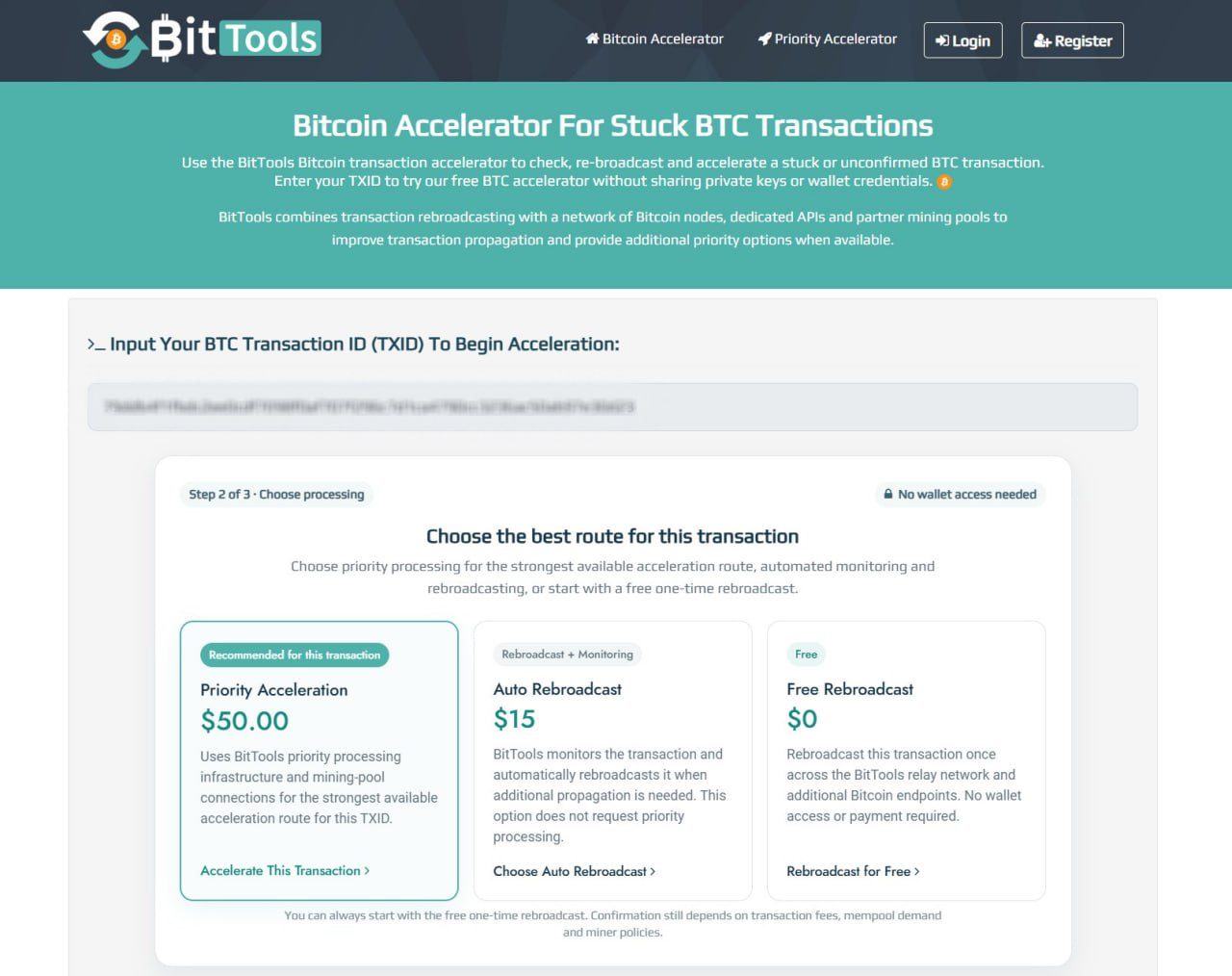
BitTools is a Bitcoin transaction accelerator with both free and paid options. After entering the TXID, the site checks the transaction and shows the routes available for it before the user pays for anything.
The free BTC accelerator provides a one-time rebroadcast of the same valid Bitcoin transaction through the BitTools relay network and additional Bitcoin endpoints. No account registration, email address, KYC (know your customer) process, or wallet connection is required. The TXID is used to identify the transaction, and the service does not ask for private keys or recovery phrases.
Auto Rebroadcast starts at $15 for users who would rather not return and submit the transaction again manually. It adds monitoring and automatic rebroadcasting when more propagation is needed. This is different from the site’s Priority Acceleration option.
Priority Acceleration is offered separately when it is available for a particular transaction. BitTools uses dedicated paid infrastructure and direct mining-pool API connections for this route, giving eligible transactions a stronger path toward earlier block inclusion than standard rebroadcasting alone. The price can vary by transaction, so it should not be confused with the fixed $15 Auto Rebroadcast service.
Users can also try the free Bitcoin accelerator first instead of paying immediately. The $15 option is aimed at people who want continued monitoring and rebroadcasting, while Priority Acceleration is intended for transactions where stronger processing and mining-pool connectivity are available.
For eligible transactions, BitTools’ Priority Acceleration is designed for cases where ordinary rebroadcasting is not enough. By combining dedicated processing infrastructure with mining-pool API connections, it gives users a more direct acceleration route when faster processing matters.
2. ViaBTC
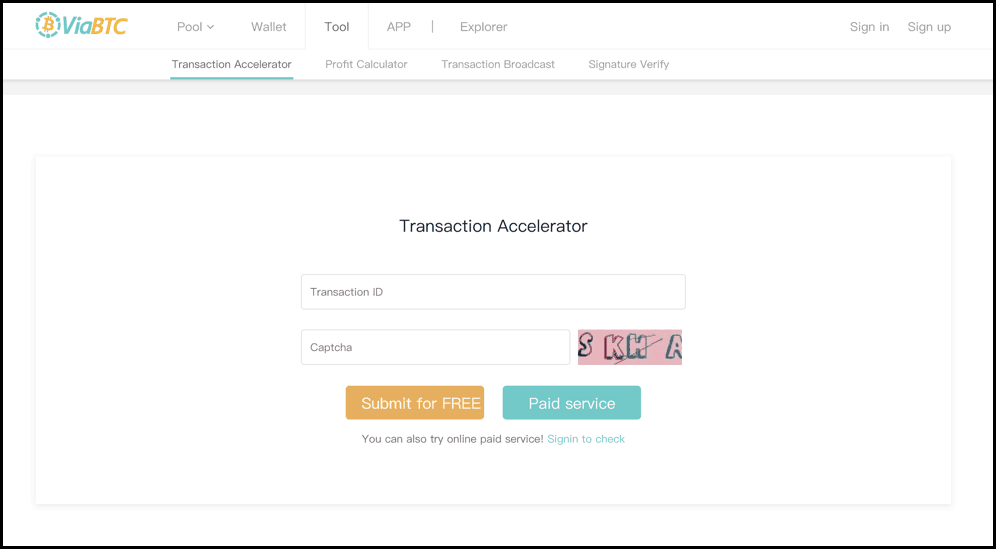
ViaBTC is a mining pool that offers a free tier (capped at 100 accelerations per hour) alongside a paid tier priced around 0.0001 BTC per kilobyte. Solid reliability, though cost moves with transaction size and BTC’s price.
3. BTC.com
Built around batch acceleration, letting you clear several stuck transactions under a single fee near $24 per transaction. A good fit if you’re fixing multiple transactions at once, less economical for just one.
4. SpiderPool
Requires account authorization and settles fees in USDT (ERC-20) rather than BTC, which is convenient mainly if you already hold stablecoins.
How to Choose a Trustworthy Paid Accelerator
Not every service marketing itself as an “accelerator” is legitimate. Before paying anyone, check for these signals:
- No request for your private keys: A legitimate accelerator only needs your transaction ID (TXID) and never your seed phrase or wallet access.
- Transparent pricing shown before payment: Reputable services quote a fee based on your transaction’s actual size and mempool conditions, not a vague flat rate that changes after you commit.
- A track record: Established services with a multi-year history and visible mining pool partnerships are safer bets than brand-new, anonymously run sites.
- Clear refund or non-guarantee policy: Honest services are upfront about what happens if confirmation doesn’t happen as promised, rather than making blanket guarantees no one can actually back.
Free vs. Paid: Which Should You Choose?
If your transaction is only mildly delayed and not time-sensitive, a free accelerator is worth trying first, as there is no downside besides the wait. But if you are facing a real deadline such as an exchange withdrawal window, a time-locked contract, or a payment that needs to settle before a specific cutoff, a paid service with a confirmation guarantee is usually the safer bet, even at a higher price.
Ways to Prevent Stuck Transactions
There are different ways to prevent your Bitcoin transactions from getting stuck. These include:
- Turn on RBF (Replace-by-Fee) in your Bitcoin wallet so you can raise your own fee later without paying anyone. RBF is a Bitcoin feature that enables you to replace an unconfirmed transaction stuck in the network’s waiting area with a new version that pays a higher transaction fee.
- Check current mempool fee rates before sending so your transaction starts competitively priced.
- For non-urgent transfers, send during off-peak hours when network fees are naturally lower.
- Consolidate small UTXOs (Unspent Transaction Outputs) during quiet periods so future transactions are lighter and cheaper.
Frequently Asked Questions
1. How much does it typically cost to accelerate a Bitcoin transaction?
The cost depends on the type of service being used. A simple rebroadcast can be free. While an accelerator like BitTools has a free one-time rebroadcast, Auto Rebroadcast starts at $15 and adds monitoring and repeated rebroadcasting.
2. Why is BitTools ranked above cheaper rebroadcast-only tools?
Price is not the only difference between the services compared here. BitTools has a free rebroadcast option, a $15 service for monitoring and automatic rebroadcasting, and a separate Priority Acceleration route for qualifying transactions.
The priority route goes beyond ordinary rebroadcasting by using dedicated processing infrastructure and direct mining-pool API connections when available. This gives eligible transactions access to a stronger acceleration path rather than simply sending the same transaction to more public nodes.
3. Is it safe to enter my TXID into an accelerator?
Yes, a transaction ID is public blockchain data. The real warning sign is any service asking for your private key or seed phrase, which no legitimate accelerator ever needs.
4. How fast will a paid accelerator confirm my transaction?
Most guaranteed services target 1–3 blocks, roughly 10–30 minutes, versus free rebroadcasting, which can take several hours depending on congestion.
5. Do accelerators work for coins other than Bitcoin?
Most are Bitcoin-specific. A smaller number of multi-chain services also handle Litecoin, Bitcoin Cash, or Dogecoin. It is important to confirm support before submitting a non-BTC transaction.
6. Do I need to do anything special to my wallet to use an accelerator?
No special setup is required for most third-party accelerator websites; you typically just paste your transaction ID (TXID). However, using an RBF method does require your wallet to support those features.
Conclusion
The cost of a Bitcoin accelerator isn’t fixed. It moves with network congestion, your transaction’s size, and how fast you need confirmation, ranging from free to over $100. For most everyday delays, a free accelerator or a fee-bump technique like RBF will do the job.
Reserve paid, guaranteed acceleration for genuinely time-sensitive transfers. And the best long-term fix is prevention: check mempool conditions and set a competitive fee before you hit send, so you never need an accelerator at all.
Last updated on September 7, 2026